Your life is a /loop
AI makes life feel like a loop. Choose what is worth repeating.
The (un)known loop
It was a rather hectic few weeks for me mentally after coming back from a month-long trip across India and China. For once, I was properly disconnected: no standups, no releases, no feed. It felt strange, but it was good.
Then I came back to work, and the strangeness did not leave. Changes were happening week after week. Priorities were shifting. New things were coming in. Yet the direction did not feel any clearer.
Stepping out for a month was what let me see it. Back inside the churn, I looked at my relatively early career so far, and realised something.
I had always been in a /loop.
As far as I can recall, I never truly had a proper break from working since my university days. It was always one thing after another: internships, projects, then working with my current team even before I officially graduated. Along the way, I drilled on software engineering, deep learning, generative AI, and now, agents.
On paper, I am probably already ahead of the curve. I was exposed to AI before it became a daily conversation. I had the chance to build things, explore ideas, and understand the space while many people were still trying to figure out what ChatGPT actually does.
But why do I seem ahead, and yet behind?
Remember the naive RAG pipeline you built a year or two ago? Sorry. It is probably outdated now. Adaptive RAG, agentic RAG, or some other new pattern that makes your previous understanding feel slightly expired.
Next moment, you realise you are scrolling through X again. You see the ever-awesome AI influencers sharing the next big thing. Someone built a cool demo over the weekend. Someone wrote a long thread about a new workflow. Someone tells you that the way you are working today is already outdated.
And then you bookmark it somewhere. Maybe you read it. You might even implement it, if you are free enough, curious enough, and still have the energy to explore.
Then boom.
Something new comes out again. And you are right back in the loop.
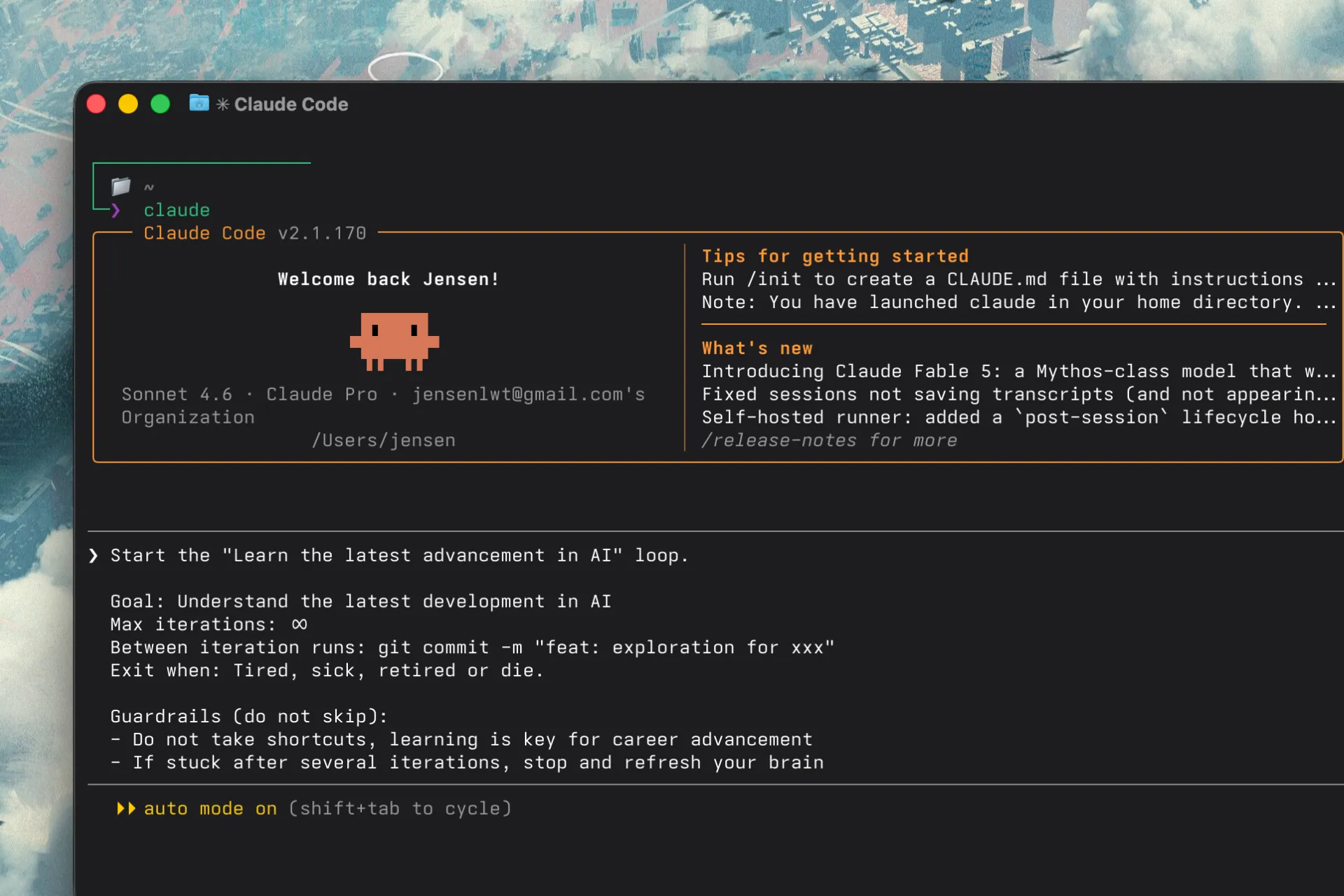
You enter a loop, knowingly or not. You learn, you catch up, and just when you think you are getting somewhere, the next thing appears.
Breadth or depth
While loops are cool for your agents, they might not be the best for you if you are not the one steering them. If I have to stay in a loop, then I want it to be a loop I choose, not one set by the feed, the hype cycle, or the fear of falling behind.
The field of AI is wide and deep. Keeping up with the breadth is easy enough. You skim a thread here, bookmark a release there. But skimming is not the same as knowing. What I actually want is to understand a few things well enough that they stop surprising me.
“How to become expert at thing:
1 iteratively take on concrete projects and accomplish them depth wise, learning “on demand” (ie don’t learn bottom up breadth wise) …”
You could argue that with Claude Max or ChatGPT Pro, you can have both. Sure, to a point. But I am done stuffing my head with knowledge that only ever turns into noise. How much do you really understand if you are always jumping from one article to the next, never staying long enough for any of it to stick?
Right now, I want to be good at building AI-native applications. Nothing fancy. Just things that quietly take real work off the people using them.
And every application you build is really a problem you are trying to solve. Anyone can get something running. The harder thing is knowing whether it actually works, and why. That messy middle, between a demo and something I would put in front of real users, is the part worth getting right.
So I stopped chasing every new thing, every new release. And started asking a different question. What do I actually want to get good at?
Looping with intent
For the past year, I worked on scaling one of the most widely adopted internal AI tools in my company. A lot of it was plumbing. Piecing together services for LLM orchestration, grounding, and so on.
In honesty, it was not always pretty. Most of it was unglamorous engineering work. We did a bit of everything, and the exposure was useful. But somewhere along the way I noticed something. I was touching a lot of things, but not going deep into the few that actually mattered to me.
So I decided to spend the rest of the year differently. I wanted to loop with intent. That means I stop chasing every new demo, framework, or thread on X, and instead pick two or three core parts of building with LLMs to go deep on, whether or not my day job gives me the chance to.
To do that, I needed a second brain.
So I started building one. The point is not to hoard information. It is to build depth without losing sight of breadth. I do not want every new topic to land as another random bookmark I never reopen. I want to connect each new idea back to the areas I actually care about: RAG, agents, evaluation, memory, tool use, and AI-native application design.
But reading only gets you so far. The fundamentals need their own feedback loop. These things are easy to talk about and much harder to build. Real understanding only shows up when you implement them, watch them break, and fix them.
The patterns look similar across applications. The trade-offs, the constraints, and the messy implementation details are what make each one different.
So I am going back to basics.
The things I have shipped a dozen times, I am tearing down and rebuilding from first principles. Remember that naive RAG pipeline? I am building mine again from scratch. Not to chase the latest agentic pattern, but to re-derive why each piece earns its place before some thread on X declares it outdated. Chunking, retrieval, reranking, evaluation. I want to feel where each one breaks, and defend every trade-off rather than repeat it.
That, to me, is looping with intent. Not escaping the loop, but choosing the one that is worth repeating.
Signed-off-by: Wei Teck Low